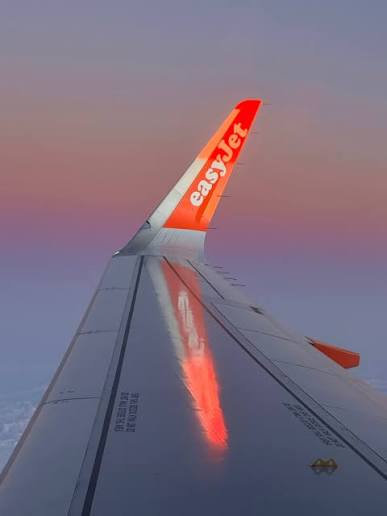
We are now in the depths of summer and also almost halfway through our annual trip back to England. The British sunshine has been surprisingly lovely and it’s been an absolute pleasure bringing my children back with me to rediscover all of my childhood memories. Needless to say, this annual trip that I used to make on my own with one little suitcase and not much effort has now become a very different experience with two little children in tow!
As you can imagine, with the stress of carrying everything, keeping everyone entertained and making sure that nobody disappears off in the airport, travelling isn't quite as enjoyable as it used to be. However, my little boy, who is now almost six years old, made the whole experience so much more exciting when he looked up at me and asked, "Mummy... are we going on the EasyJet or the HardJet today?"
A very simple question. A little funny moment. But one that really got me thinking.
Where on earth had that come from? I certainly hadn't taught him that. And that's when the teacher brain starts spiralling...
We land. We unpack. The laptop comes out. The books come out. And, because I simply can't help myself, I start researching.
Luckily, I'd packed a copy of How Languages are Learned by Lightbown and Spada in my suitcase because I'd promised myself I would finally start making my way through it this summer. As luck would have it, the very first chapter started talking about Behaviourism, and suddenly everything just clicked. As I was reading about how children hear language, copy it, receive feedback and gradually build correct language habits, I couldn’t help wonder if there were more sides to the story. And whilst I completely agree that there is huge value in this (it's something I use in my own classroom all the time!), it still didn't answer my question…
Where had HardJet come from?
Nobody had ever said that to him or taught him that.
Instead, he'd done something much more interesting. He'd noticed a pattern. Easy has an opposite. So naturally... EasyJet must have one too.
Isn't that incredible?
His language wasn't technically correct, yet there was nothing grammatically incorrect about it at all.
His thinking was completely logical. And I think that's the part that fascinated me the most. Without any help from me whatsoever, he'd taken the language he already knew, recognised a relationship between words, applied his own reasoning and confidently produced something brand new. It wasn't something he'd memorised. It wasn't something he'd copied.
He'd created it.
As teachers, we spend so much time correcting mistakes that sometimes we forget to stop and ask ourselves a much more interesting question.
Why did the learner say that?
Because behind almost every mistake is simply a learner trying to make sense of the language.
In fact, the more I thought about it, the more I realised that I see this happening in my classroom all the time. Children say things like “goed” or “eated”, not because they haven't been listening, but because they've found a rule and they're trying it out. They're experimenting. They're making predictions. They're testing whether the language behaves in the way they think it should.
And honestly... I think that's beautiful.
Don't get me wrong. Behaviourism is an incredibly important theory and one that absolutely has its place in language learning. Repetition, modelling and positive reinforcement all play an essential role in helping learners build confidence and fluency, and honestly, it really is such a huge part of my classroom. But this tiny conversation in an airport reminded me that there is something much bigger happening too.
Children aren't just repeating language.
In their very own brains, they are thinking, searching for patterns and solving problems.
They are building their own understanding of how language works.
And perhaps that's one of the greatest privileges of being a teacher.
Every now and then, if we stop looking for mistakes and start looking for thinking instead, we get a tiny glimpse into the incredible way children make sense of the world. And maybe, that is the purest form of education there is.